China’s AI Rules Are Really About Proof

![Header graphic: China's AI Rules Are Really About Proof, with the flag of the People's Republic of China and the Chinese title of the Supreme People's Court Opinions, Fa Fa [2026] No. 10, September 7, 2026. By Erick Robinson.](https://static.wixstatic.com/media/b902f0_484285dac4c14da7ae3d7a7dfcf5c639~mv2.png/v1/fill/w_980,h_551,al_c,q_90,usm_0.66_1.00_0.01,enc_avif,quality_auto/b902f0_484285dac4c14da7ae3d7a7dfcf5c639~mv2.png)
The patent owners who should pay closest attention may never have filed an AI case.

The Official Chinese language version of the opinion from the Supreme People's Court juxtaposed with an unofficial English translation.
THE MODEL IS NOT THE WHOLE CASE

Original editorial illustration: the dispute connects human contribution, machine behavior and evidence.
Imagine a patent dispute over an industrial inspection system. The product flags defective components. Its vendor calls the underlying model proprietary. The customer has the outputs, the integrator has the deployment logs, and the developer has the training records. Meanwhile, the patent owner used AI to help develop the invention—and cannot clearly reconstruct what its engineers contributed.
This is a hypothetical, not a reported case. It illustrates the real question behind China’s new AI litigation guidance: when the relevant knowledge is scattered across people, models and companies, who must explain what happened—and with what proof?
On September 7, 2026, China’s Supreme People’s Court published its Opinions on Trying Artificial-Intelligence-Related Dispute Cases in Accordance with Law, Fa Fa [2026] No. 10. The 24 provisions address torts, intellectual property, evidence, litigation conduct and judicial coordination. The Court describes the instrument as its first dedicated AI judicial adjudication rules document. [Chinese text]
The most useful reading is not “China has solved AI law.” It is that China’s highest court has told judges where to look when AI makes responsibility difficult to see. For patent owners, that direction matters on both sides of the courtroom: proving infringement and defending the legitimacy of the invention itself. Here is an unofficial English full translation and here is a bilingual version with the English and Chinese aligned together.
Note on translation and scope: Quotation panels place the unofficial English translation beside the corresponding Chinese excerpt. The Chinese text controls. Quotations should receive bilingual legal review before legal reliance. The source is the official Chinese text published by the Supreme People’s Court. Hypotheticals and strategic recommendations are the author’s analysis, not additional rules announced by the Court.
01 / THE PURPOSE
A playbook, not a code
Start with the form of the document. These are institutional Opinions, not judgments deciding particular disputes. The instrument supplies adjudicative guidance grounded in existing statutes; it should not be presented as a new omnibus AI statute or casually relabeled a formal judicial interpretation. Its introduction expressly identifies the Civil Code, intellectual-property statutes, data laws and the Civil Procedure Law as its legal foundation. [Chinese text]
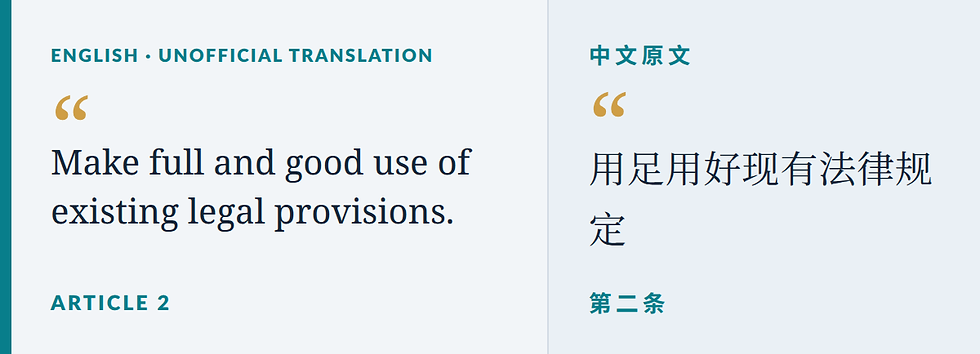
Article 2 · 第二条 · Chinese source
The accompanying release acknowledges that China has not enacted a dedicated AI law and describes the objective as drawing legal boundaries while supporting technological innovation. Article 2 asks courts to foster an environment that “encourages exploration and tolerates failure,” while preventing algorithmic discrimination and protecting rights. These are simultaneous instructions, not competing press releases. [Chinese text]
THREE OBJECTIVES, ONE ADJUDICATION FRAMEWORK

Article 2: protect people, support innovation and maintain safety. None eliminates the others.
The political and institutional framing matters. The text expressly connects adjudication to national development priorities, Party policy and security. But that framing does not make its operational instructions irrelevant to a litigant. A judicial document can serve public-policy objectives and still supply precise arguments about consent, human inventorship, evidence production and fault. Understanding Chinese law requires reading both layers. [Chinese text]
Article 3 supplies the default liability rule: where legislation does not specify no-fault or presumed-fault liability, courts apply the Civil Code’s fault-liability principle. Judges must consider the application scenario, autonomy, transparency, risks, preventive measures and the user’s ability to foresee and control harm. That default does not displace a different rule supplied by an applicable statute. [Chinese text]

Article 3 · 第三条 · Chinese source
The strategic point is narrower—and more useful—than saying liability always follows control. Control is an important fact, not the entire legal test. A provider should be ready to explain which risks it could reduce, what it actually did, and which decisions belonged to someone else. A claimant should be ready to challenge that explanation.
02 / THE INVENTOR
When the machine helps invent
The patent provision puts a human question inside a technical test. Article 14 recognizes AI-related inventions that use technical means following natural laws, solve a technical problem and achieve a corresponding technical effect. But it excludes, among other things, cases in which “no natural person has made a substantive contribution.” [Chinese text]

Article 14 · 第十四条 · Chinese source
Using AI is not disqualifying. Nor does being the person who operated the system automatically establish inventorship. The distinction is the human’s contribution to the invention—not ownership of the subscription, authorship of a generic instruction, or the number of hours spent supervising a screen.
PRESERVE THE CONTRIBUTION, NOT JUST THE OUTPUT
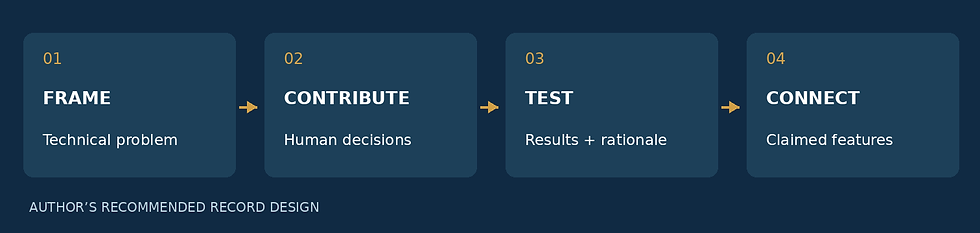
Recommended record structure. These are documentation steps, not a four-part legal test.
Return to the inspection-system hypothetical. An engineer’s instruction to “improve accuracy” says little about the contribution to a later-claimed technical feature. A dated record explaining why the engineer changed the sensing architecture, selected a particular processing sequence and rejected alternatives can tell a much more specific story. Which acts actually establish inventorship remains a legal and factual question; the point is to preserve enough detail to ask it intelligently.
For a patent owner, I would organize that record around the claimed features: the relevant human decision, its technical rationale, the model’s role, and the contemporaneous evidence. A huge archive of prompts is not necessarily a useful inventorship record. Provenance must connect to substance.
Article 14 also addresses disclosure: the specification must describe the technical solution sufficiently for “a person of ordinary skill in the art to carry out the invention.” The Opinions do not say every AI patent must disclose all training data, source code or model weights. They restate an implementation-focused requirement; whether particular technical details are necessary depends on the invention. [Chinese text]
“We used AI” is not the weakness. “We cannot explain the human contribution” may be.
03 / THE EVIDENCE
The black box meets the courtroom
The sentence most likely to catch a litigator’s eye appears in Article 12:

Article 12 · 第十二条 · Chinese source
That is consequential language. But its location is equally consequential: the surrounding discussion concerns copyright infringement. It is not sound to lift this sentence out of that setting and announce a universal right to obtain an accused patent infringer’s training corpus. The next sentence also requires a rights holder alleging copyright infringement through algorithmic technology to provide relevant evidence. The claimant’s job has not disappeared. [Chinese text]
DO NOT TURN A COPYRIGHT RULE INTO PATENT DISCOVERY
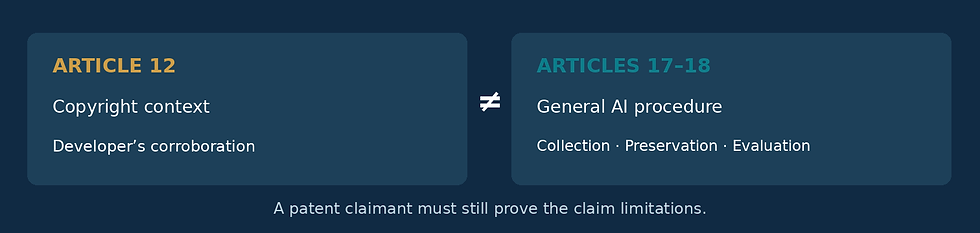
Article 12’s context matters. Articles 17–18 provide the broader procedural framework.
Patent litigators have a more disciplined route. Article 17 addresses AI-related disputes generally. A party unable to collect evidence for objective reasons may seek court investigation and collection. Courts must promptly examine applications to preserve evidence relating to key technology. The provision also supplies an adverse-inference mechanism. [Chinese text]
An evidentiary tool is not a substitute for an infringement theory.
03 / THE EVIDENCE — CONTINUED
Who controls the missing proof?
Article 17’s adverse-inference language is worth reading in full, rather than treating it as a slogan about transparency:

Article 17 · 第十七条 · Chinese source
The distinction between “shall” in Article 12 and “may” in Article 17 deserves attention. The latter is not an automatic victory after a document request goes unanswered. The text requires control, an unjustified refusal and the relevant assertion by the opposing party. The legal and factual predicates still matter. [Chinese text]
The practical task is therefore to identify a specific disputed proposition, the evidence likely to resolve it and the party controlling that evidence. “Give us everything about your AI” is a demand. Explaining why a particular record resolves a particular disputed limitation is an evidentiary theory.
An AI output can look conclusive while leaving its cause unresolved. Did the behavior come from model training, fine-tuning, a system instruction, retrieved material, a connected tool or the tester’s prompt? Those are alternative explanations to investigate—not mechanisms the Opinions declare equivalent.
First identify what must be proved. Then identify who can prove it.
03 / THE EVIDENCE — CONTINUED
A screenshot is not an experiment
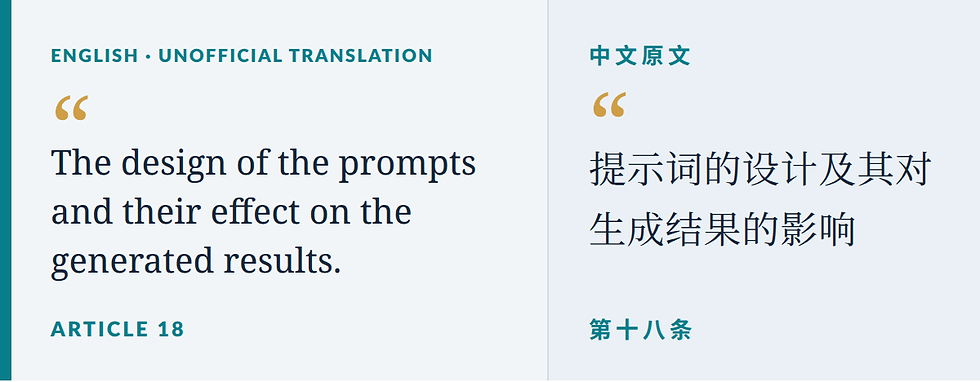
Article 18 · 第十八条 · Chinese source
Article 18 asks courts considering AI-generated infringement evidence to examine prompt design, similarity to the work in which rights are claimed, consistency across repeated tests, and the model’s training, algorithm design and filtering mechanisms. Its reference to the claimed work is particularly pertinent to copyright. It is not a substitute for proving the limitations of a patent claim. [Chinese text]
FROM STRIKING OUTPUT TO DEFENSIBLE EVIDENCE

Recommended testing protocol inspired by Article 18, not a prescribed statutory checklist.
For the inspection-system case, I would preserve the model and product version, system configuration, relevant input, settings, timestamps and full results—including runs that do not support the theory. I would record which elements of the environment were under the tester’s control. Repetition helps evaluate a result; it does not by itself reveal the internal steps that produced it.
This is where AI expertise changes legal strategy. A model that produces inconsistent answers does not necessarily fail to practice a claimed method. Conversely, one successful output does not necessarily establish that every claimed operation occurred. The experiment must be designed around what the claim requires, rather than around what makes the demonstration look impressive.
Article 18 also directs courts to examine the authenticity and integrity of electronic data throughout generation, collection, storage and transmission. For blockchain evidence, it highlights “the authenticity of the data before it was placed on-chain.” For big-data reports, it highlights raw-data sources, cleansing rules and the scientific soundness of the analytical methods. [Chinese text]
An immutable record can faithfully preserve a falsehood.
That is the distinction between proving that a file has not changed and proving that its contents are true. The Opinions expressly require attention to both kinds of problem. Article 17’s use of technical investigation officers, appraisers and expert assistants reinforces the importance of explaining the technical mechanism, rather than merely presenting its output. [Chinese text]
04 / THE SUPPLY CHAIN
Buy access to the evidence
The same company may be a patent owner in one dispute, an integrator in another and a customer in a third. Its contract should anticipate those different roles. Article 15 tells courts addressing AI technology contracts to consider the agreement, the characteristics of AI development and “whether the technology developer made reasonable efforts.” Article 12’s copyright allocation considers participation, preventive measures, training-data sources and profits. [Chinese text]
THREE PARTIES. THREE DIFFERENT EVIDENCE STORES.

Illustrative allocation only; actual custody and legal responsibility depend on the facts.
The drafting implication is not simply “add indemnity.” A promise to reimburse losses does not necessarily supply records needed to avoid those losses. An indemnity can be financially useful and operationally inadequate.
My priority would be a litigation-assistance clause identifying the records each party must retain, the events triggering preservation, the process for obtaining technical witnesses and the permitted method of producing sensitive material. It should address version changes, access after termination, confidentiality and applicable data restrictions. These are recommended contract terms, not clauses mandated verbatim by the Opinions.

Article 13 · 第十三条 · Chinese source
That phrase is part of Article 13’s treatment of free, open-source code modules. The Court permits an exemption from downstream infringement liability in the stated circumstances; it also directs attention to license terms, restrictions, compliance measures and disclosure. It is not blanket immunity for anything marketed as open source, and a license label does not answer every question about another party’s rights. [Chinese text]
For physical AI products, Article 9 separately focuses on defects, updates, user control and truthful warnings about applicable scenarios, inherent limitations and foreseeable risks. Article 11 permits courts investigating driving accidents to require necessary vehicle data from producers, sellers, operators and other data controllers. These are scenario-specific rules, not universal production commands. [Chinese text]
The best indemnity may be the one accompanied by the records needed to win.
05 / THE WIDER CONSEQUENCES
China’s rules do not stay local
The international significance starts with exposure, not imitation. A foreign developer whose technology reaches a Chinese product, customer or dispute may need to explain decisions made outside China. A global company can therefore face a Chinese evidentiary question about a globally managed system. That is a practical consequence to plan for—not a claim that the Opinions independently create worldwide jurisdiction.
HOW A DOMESTIC FRAMEWORK AFFECTS GLOBAL BUSINESS

Potential operational effects, not an assertion of extraterritorial jurisdiction or foreign adoption.
Article 24 expressly calls for “alignment of rules and mutual learning” in international judicial cooperation. Article 22 directs the use of higher-court handling for specified significant or difficult cases and of the People’s Courts Case Database to promote consistency. The mechanism for influence is both outward-facing cooperation and inward-facing development of adjudication practice. Neither guarantees that foreign courts will follow China’s approach. [Chinese text]
Equally important is what the document does not settle. Article 6 generally protects processing of publicly disclosed personal information for model training only within a reasonable scope and absent an express refusal. It requires consent where processing significantly affects individual rights and directs attention to sensitivity, necessity and reasonable expectations. [Chinese text]
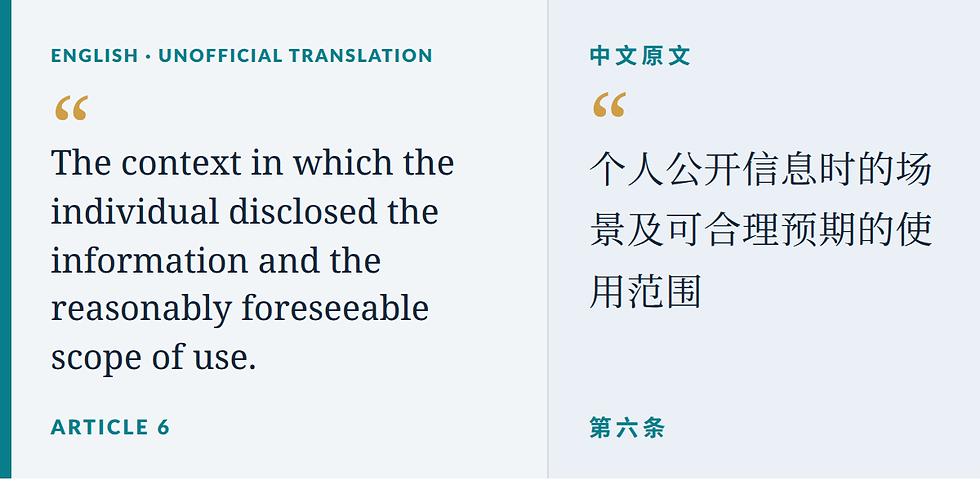
Article 6 · 第六条 · Chinese source
That is not permission to train on everything found online. A personal-information question and a copyright question are different questions, even when they concern the same file. Article 16 separately recognizes protection for qualifying copyrighted compilations and trade-secret data. [Chinese text]
The same caution applies to personality rights. Articles 4–8 address identifiable AI likenesses and voices, privacy, doxxing, notice-responsive duties and injunctions. In Article 7, responding to a notice can require stopping generation of infringing content—not merely removing an existing page. Operationally, a provider may need the ability to change future behavior as well as address past output. [Chinese text]
05 / THE WIDER CONSEQUENCES — CONTINUED
The lawyer is inside the system
A final provision makes the framework uncomfortable in the right way. The technology used to prepare the case is also subject to scrutiny.

Article 19 · 第十九条 · Chinese source
For litigation documents and case-search reports generated with AI, Article 19 requires verification, an explanation of AI assistance upon submission, and responsibility for authenticity and accuracy. It also addresses forged evidence and specified sham-litigation conduct, with sanctions and possible criminal responsibility where the relevant conditions are met. Not every bad model answer is a crime; nor does the provider’s disclaimer discharge the submitting party’s responsibility. [Chinese text]
A LITIGATION-READY AI RECORD

Recommended priorities derived from Articles 14 and 17–19; not a guarantee of admissibility or success.
For foreign rights holders, the right response is neither reflexive distrust nor uncritical enthusiasm. Written standards do not eliminate discretion, enforcement risk or the need for experienced Chinese counsel. They do identify propositions that can be tested against the record: Was there a substantive human contribution? Who controlled the evidence? Was refusal justified? Did the testing establish what its proponent claims?
My practical priorities would be to connect human development records to claimed features, map relevant technical evidence to its custodians, preserve reproducible tests, negotiate access before a dispute, and establish verification and disclosure procedures for AI-assisted filings. The objective is not to create the largest archive. It is to preserve the right facts in a form that someone outside the engineering team can evaluate.
The deeper insight is that the AI “black box” is often several different problems disguised as one: uncertain technical causation, divided custody, missing records and disputed legal responsibility. The Opinions do not solve every one of those problems. They tell litigants that describing the system as complicated will not be enough.
The company that can explain its AI may be better positioned than the company that can merely operate it.
For a patent owner, preparation begins before the complaint—and sometimes before the patent application. Preserve the human contribution. Preserve the relevant machine behavior. Preserve the ability to obtain and explain the evidence. When the courtroom finally asks who did what, the answer should not depend on reconstructing a vanished experiment.


Comments